





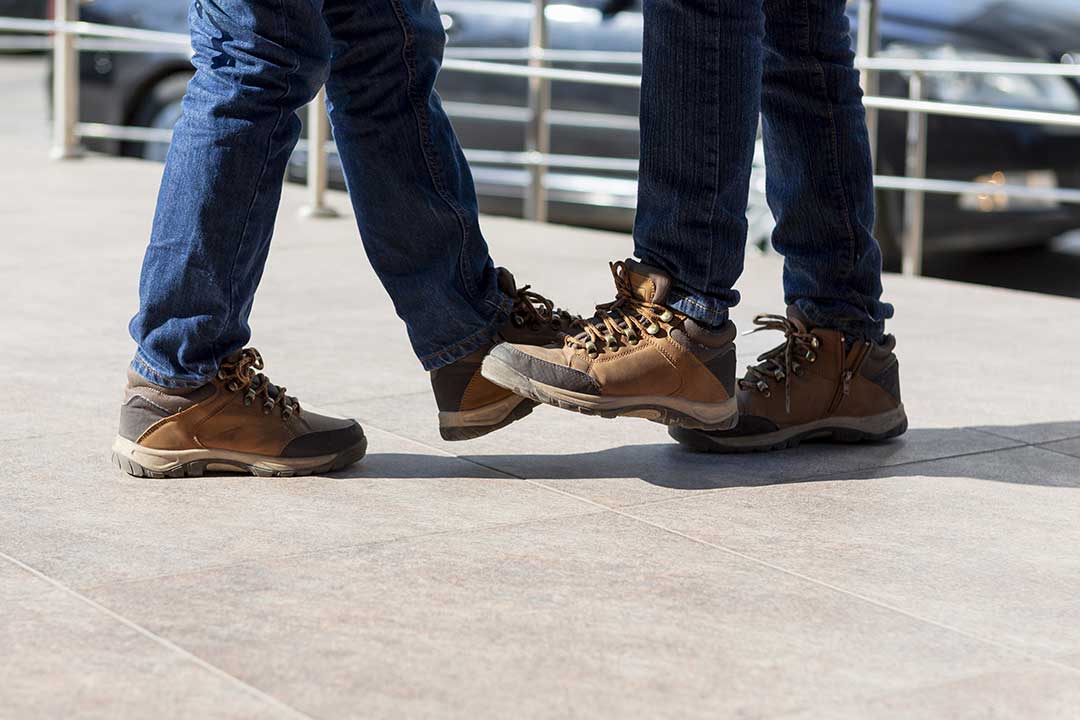
Foot injuries on industrial sites are more common than most people realise. Crushed toes, puncture wounds from nails and sharp objects, slips on wet or oily surfaces, and ankle injuries from uneven terrain are all regular occurrences across construction and industrial sites in Abu Dhabi. The right safety footwear prevents the majority of these incidents. The wrong footwear, or no footwear at all, leaves workers exposed to risks that are entirely avoidable.
What makes footwear selection more complicated than it appears is the range of standards, classifications, and material options available. Walking into a PPE supplier and asking for safety boots without understanding what your environment actually requires is a common mistake, and it often leads to either overspending on features you do not need or, more dangerously, under-protecting workers against the hazards they face every day.
The EN ISO 20345 Standard Explained
Safety footwear sold in the UAE market is most commonly certified to EN ISO 20345, the international standard covering industrial safety boots and shoes. This standard defines the basic requirements all certified footwear must meet, including a toecap capable of withstanding 200 joules of impact and 15 kilonewtons of compression.
Beyond this baseline, footwear is classified into categories based on additional protective features. Understanding these categories is the practical starting point for anyone responsible for sourcing safety footwear in Abu Dhabi.
SB is the base category, meeting only the minimum requirements of the standard. You will rarely see SB footwear specified on professional industrial sites because it lacks several features that worksites commonly require.
S1 adds antistatic properties, energy absorption in the heel, and fuel oil resistance to the outsole. This makes it suitable for general indoor industrial environments where the floor is relatively clean and dry.
S1P includes everything in S1 plus a penetration-resistant midsole that protects the foot from sharp objects puncturing through the sole. This is the most widely used category across construction sites in Abu Dhabi, where nails, rebar offcuts, and sharp aggregate are common underfoot hazards.
S2 adds water resistance to the upper, on top of the S1 features, without the penetration-resistant midsole.
S3 combines water resistance with the penetration-resistant midsole, making it the most comprehensive general-purpose category. S3 boots are the standard choice for outdoor construction work, civil engineering, and any environment where both wet conditions and sharp object penetration are realistic risks.
Additional Features Worth Understanding
Beyond the main classification categories, safety footwear can carry additional performance ratings that matter in specific environments.
HRO indicates heat resistance in the outsole, relevant for workers in foundries, near furnaces, or on surfaces that reach high temperatures.
CI and HI refer to cold insulation and heat insulation respectively, covering the thermal properties of the footwear for workers in temperature-controlled environments.
SRC is the slip resistance rating, covering performance on both ceramic tile with sodium lauryl sulphate solution and steel with glycerol. This is an important consideration for workers in food processing, hospitality support roles, or any environment with wet or greasy floors.
ESD and A refer to electrostatic dissipation and antistatic properties respectively, relevant for workers in environments sensitive to static electricity such as electronics manufacturing or certain chemical handling areas.
When building a footwear specification for a specific role, look at the full list of additional markers rather than focusing only on the S category. A worker in a steel fabrication plant may need S3 footwear with HRO outsoles. A worker in a cold storage facility has entirely different requirements.
Why Fit Matters as Much as Specification
A safety boot that meets every required specification but does not fit correctly is a problem. Boots that are too tight cause blisters and fatigue. Boots that are too loose reduce stability and increase the risk of trips and ankle injuries. Over a long shift in Abu Dhabi's heat, an uncomfortable boot that a worker wants to remove creates a compliance problem as well as a comfort one.
When procuring safety footwear for a workforce, allow for proper sizing across the full range your team requires. If possible, give workers the opportunity to try footwear before bulk orders are placed. The small additional effort at the procurement stage pays off in better compliance and fewer comfort-related complaints during the project.
Sourcing Safety Footwear in Abu Dhabi
Perfactive supplies a full range of EN ISO 20345 certified safety footwear across Abu Dhabi, covering S1P through S3 categories and a range of specialist additional features for specific industrial environments. We work with contractors and HSE teams to identify the right specification for each role and support both initial project supply and ongoing replenishment.
Safety footwear is one of those PPE categories where the details genuinely matter. The difference between S1P and S3, or between a boot with and without an HRO outsole, is not a minor technical distinction. In the right environment, it is the difference between adequate protection and a serious foot injury. Getting the specification right from the start is always worth the additional effort.