





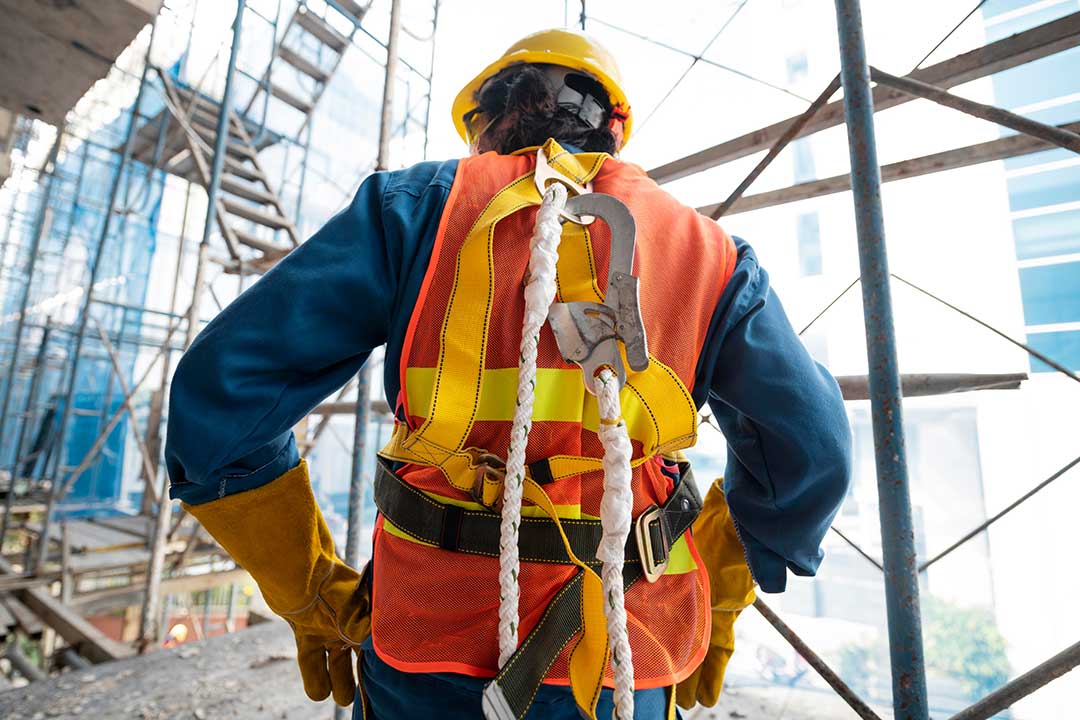
Most worksites in Abu Dhabi have some form of fall protection in place. What far fewer sites have is a credible rescue plan for when that protection is triggered. Perfactive supplies complete fall protection and rescue equipment across Abu Dhabi, helping construction companies, industrial operators, and facility managers build work-at-height programmes that go beyond basic compliance. Our equipment is fully certified, our team understands OSHAD requirements, and we are ready to support your site today. Contact us on WhatsApp or visit perfactive.ae to speak with our team.
The Gap Between Fall Arrest and Fall Rescue
There is an important distinction that many site managers do not fully appreciate until they are faced with an actual incident. Fall arrest and fall rescue are two separate challenges that require two separate sets of equipment and planning.
Fall arrest equipment, the harness, lanyard, and anchor system, is designed to stop a fall from becoming a fatal drop. It does its job in a fraction of a second. But when a worker is left suspended in a harness after a fall, a new and equally serious risk begins immediately.
Suspension trauma, also known as harness hang syndrome, occurs when a worker is suspended motionless in an upright position for a period of time. The harness leg straps compress the veins in the legs, restricting blood flow back to the heart. Within minutes, this can cause the worker to lose consciousness. If rescue does not happen quickly, the consequences can be fatal even when the initial fall itself causes no injury.
This is why rescue planning is not an optional addition to a fall protection programme. It is an integral part of it. The question every site manager needs to answer before work begins is not just how will we prevent a fall, but what will we do in the next few minutes if someone is suspended after a fall.
What a Complete Rescue System Looks Like
Rescue equipment for work-at-height scenarios varies depending on the environment, the height involved, and the number of workers at risk. At its core, a rescue capability requires the means to reach a suspended worker quickly and lower them safely to the ground or a safe platform.
Rescue descent devices allow a rescuer to descend to a suspended worker or to lower the worker from above. These are compact, purpose-designed devices that are simple enough to be used quickly under the stress of an actual incident.
Tripod rescue systems are used for confined space and elevated rescue scenarios where a direct approach from above is required. The tripod provides a stable anchor point above the rescue location, with a winch or descender that allows the worker to be raised or lowered as needed. These systems are particularly relevant for tank entry, manhole work, and any confined space application where fall protection and rescue are required simultaneously.
Rescue stretchers and evacuation chairs are relevant for scenarios where a worker has sustained an injury during or after a fall and cannot be moved in a standing position. Getting an injured worker down from height safely requires equipment designed for horizontal evacuation.
Personal rescue devices are compact units that allow a worker to self-rescue by descending slowly to the ground in the event of a fall when no rescuer is immediately available. These are not a substitute for a full rescue plan but can provide an additional layer of capability in certain scenarios.
OSHAD Requirements for Rescue Planning
OSHAD regulations in Abu Dhabi require employers to have emergency and rescue procedures in place for all work-at-height activities. This is not a general statement about having a first aid kit on site. It means a documented procedure, trained personnel, and the physical equipment to execute a rescue within the timeframe that suspension trauma demands.
An inspection or audit of your work-at-height programme will typically include questions about rescue capability. Can you demonstrate that your team knows what to do if someone is suspended? Is the rescue equipment present, accessible, and in serviceable condition? Have the workers who would execute a rescue been trained to do so?
These are not difficult standards to meet, but they require deliberate planning and the right equipment. Many sites fail on rescue readiness not because of lack of intention but because rescue planning is treated as something to address after the fall protection system is in place, rather than as part of the same programme.
Common Rescue Planning Mistakes
Relying on emergency services as the rescue plan is one of the most common and most dangerous assumptions made on Abu Dhabi worksites. Emergency response times, even in urban areas, are measured in minutes. Suspension trauma can become critical in that same timeframe. By the time paramedics arrive at a suspended worker, the window for a safe outcome may already have closed.
Having rescue equipment on site but no trained users is another frequent gap. A tripod system sitting in a storage container is not a rescue capability. The people who would use it in an emergency need to have practised with it under realistic conditions, not simply read the manual.
Failing to account for the specific rescue scenario is also a common error. A rescue plan developed for scaffolding work may be entirely unsuitable for a confined space entry on the same site. Each distinct work-at-height scenario needs its own rescue procedure that reflects the actual access, equipment, and personnel available.
Building a Work-at-Height Programme That Covers Both
The most effective approach to work-at-height safety integrates fall arrest and rescue planning from the beginning rather than treating them as separate considerations. Before any work at height begins on your site, the following should be in place.
A site-specific fall protection plan that identifies all work-at-height tasks, the fall arrest systems to be used, and the anchor points or structures they will connect to. A rescue procedure for each distinct scenario, covering how a suspended worker will be reached and lowered within the critical timeframe. Trained personnel who have practiced the rescue procedure with the actual equipment they will use. Rescue equipment that is accessible, inspected, and ready for immediate use. Documentation that covers all of the above, ready for OSHAD audit review.
Why Choose Perfactive
Perfactive supplies fall protection and rescue equipment to clients across Abu Dhabi, including construction contractors, industrial facility operators, oil and gas companies, and facility management teams. Our range covers full-body harnesses, energy-absorbing lanyards, self-retracting lifelines, anchor devices, horizontal lifeline systems, tripod rescue systems, descent devices, and confined space rescue equipment.
We work with HSE managers to understand the specific work-at-height scenarios on each site and recommend the right combination of fall arrest and rescue equipment for each application. All products are fully certified and backed by the documentation your team needs for OSHAD compliance and internal audit purposes.
Contact Perfactive today on WhatsApp or through perfactive.ae. Our team is ready to help you build a work-at-height programme that is genuinely complete, from the first line of fall prevention through to a credible and practiced rescue capability.
A fall protection programme that stops at the harness and lanyard is only half a programme. The other half is knowing exactly what happens in the minutes after a fall is arrested, having the equipment to respond, and having people on site who are trained and ready to use it. In Abu Dhabi's industrial and construction environment, that complete approach is what responsible work-at-height management looks like.
Fall protection is one area of PPE where there is genuinely no room for compromise. The consequences of getting it wrong are immediate and irreversible. Choosing certified equipment, using it correctly, maintaining it properly, and having a rescue plan in place — these are not optional extras. They are the minimum standard for any organisation sending workers to height in Abu Dhabi.